
“Menta Bergamotto” isn‘t actually mint – Here’s what I bought instead
I picked up and bought a pot labelled “Menta Bergamotto” expecting another mint for my collection. Then when I got home, I looked at the tag properly. It read: Monarda didyma. That’s not a mint. Here’s the honest story of what I actually bought, why it’s sold under a mint name anyway, and how to tell it apart from the real thing.
The short answer: “Menta Bergamotto” is a common nursery name in Italy for Monarda didyma, known in English as bee balm, scarlet bee balm, or Oswego tea. It’s a genuine member of the wider mint family (Lamiaceae), which is why its leaves smell aromatic and “minty,” but it belongs to a completely different genus (Monarda, not Mentha) and isn’t a true mint at all. It’s native to eastern North America, not the Mediterranean, and its own English common name “bergamot” is a complete coincidence that has nothing to do with true bergamot mint.
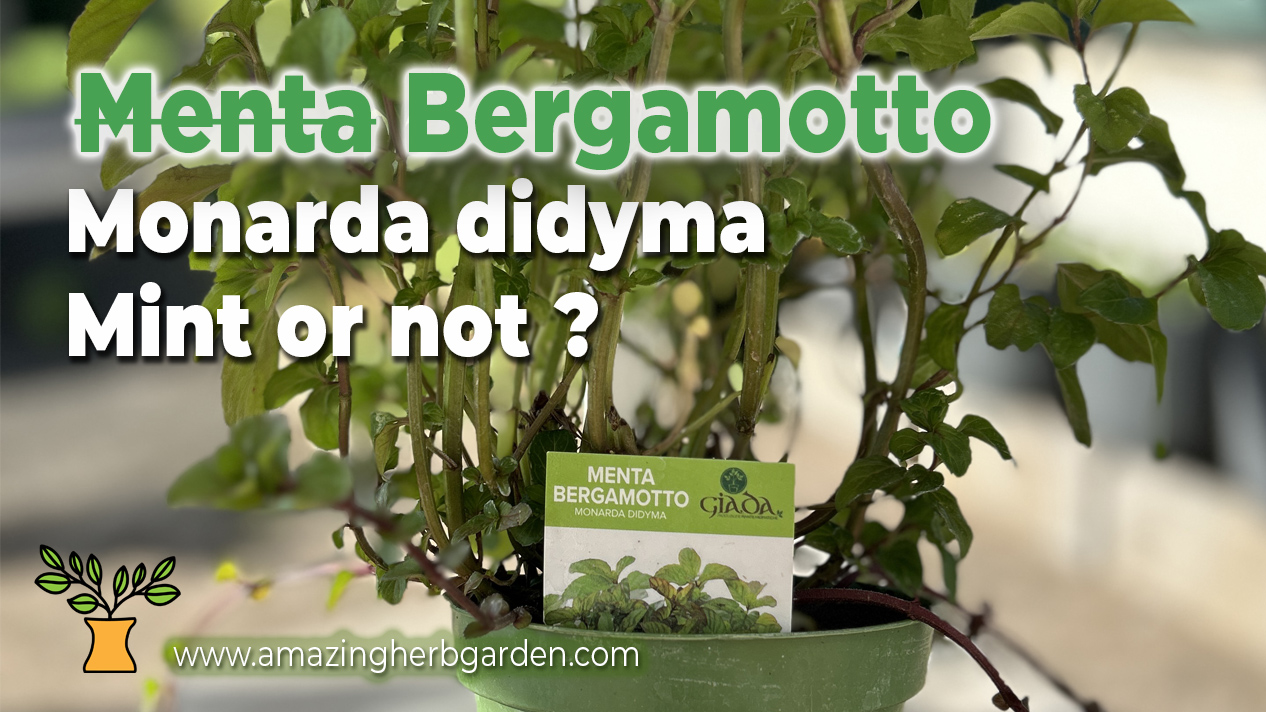
What actually happened when I read the tag
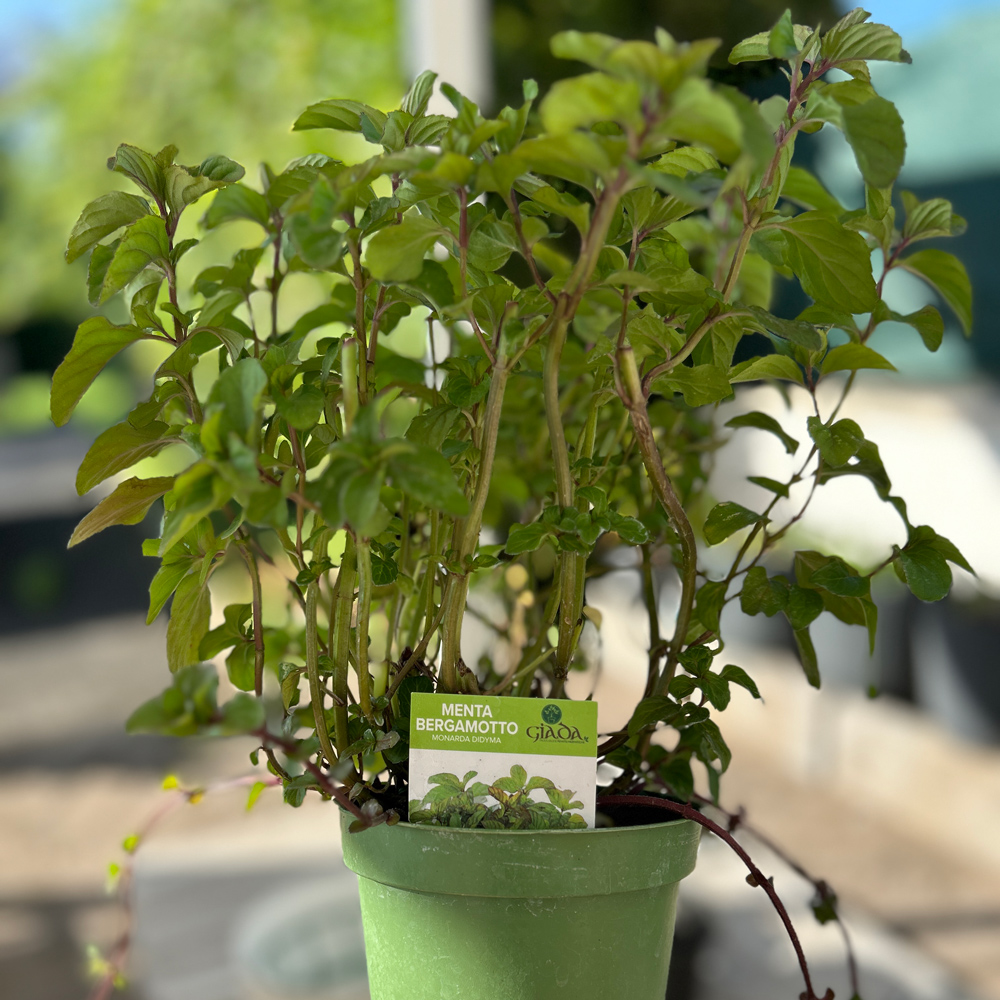
I potted this up alongside two genuine mints — glacial mint and orange mint — on the same day, all three bought as a batch from the same nursery. It was only when I sat down to write about them that I actually read the small print on this one’s tag properly: “MENTA BERGAMOTTO” in large type, “MONARDA DIDYMA” printed underneath in smaller letters.
That’s the moment this stopped being a straightforward “new mint variety” post and became something more interesting. Monarda is not Mentha. Different genus entirely. I want to be upfront that I nearly wrote this up as a normal mint-variety guide before catching it — which is exactly the trap I want to help you avoid too.
So what is Monarda didyma, really?
Monarda didyma goes by several English common names: bee balm, scarlet bee balm, crimson bee balm, Oswego tea, horsemint — and yes, bergamot, which is almost certainly where the Italian nursery name “Menta Bergamotto” comes from.
Key facts, verified against horticultural references:
- Family: Lamiaceae — the same wider mint family that true mints, basil, rosemary, sage and lavender all belong to. This matters: it’s a genuine relative, not a random impostor from an unrelated plant family. That’s also exactly why its leaves smell aromatic and “minty” when crushed, even though it isn’t a Mentha species.
- Native range: eastern North America — woodland edges, damp meadows and streambanks — not the Mediterranean or Europe at all.
- Flowers: large, showy, two-lipped tubular flowers packed into dense, globular flower heads roughly 7–10 cm (3–4 in) across, in shades of scarlet red, magenta or lavender-pink depending on variety, often sitting above a whorl of colourful bracts.
- Leaves: lance-shaped (long and pointed, tapering at both ends), rather than the more rounded, serrated leaves typical of true mints.
- History: used historically by Indigenous peoples, including the Oswego people of what’s now New York State, for tea and traditional remedies — which is where the “Oswego tea” name comes from.
Why is a non-mint being sold as “menta”?
I want to be fair here rather than assume bad intent on the nursery’s part. A few honest possibilities:
- Its foliage genuinely does smell aromatic and mint-family-adjacent when crushed, thanks to shared aromatic compounds across Lamiaceae — so calling it “menta” isn’t a wild stretch the way, say, calling a rose “menta” would be.
- Italian retail nursery labelling for aromatic/culinary plants often groups anything mint-scented under a “menta” branding umbrella for shoppers, prioritising a recognisable, marketable name over strict botanical accuracy.
- It may simply reflect how the plant is commonly known and sold across parts of Europe, regardless of its botanical accuracy — the same pattern I’ve already run into with menta romana potentially being pennyroyal.
Whatever the reasoning, the practical lesson for you as a buyer is the same one I keep coming back to on this site: a nursery tag’s common name is a starting point, not a guarantee. The botanical Latin — when it’s given at all — is the thing actually worth checking.
How to tell Monarda didyma apart from true mint
If you’ve bought something labelled “menta” anything and want to check what you’ve actually got, here’s what to look for:
| Feature | True mint (Mentha) | Monarda didyma |
|---|---|---|
| Leaf shape | Rounded to oval, often serrated edges | Lance-shaped, tapering, pointed at both ends |
| Flowers | Small, pale, in slim terminal spikes or whorled rings up the stem | Large, showy, globular heads of tubular blooms — often red, pink or lavender |
| Flower size | A few millimetres per flower | Each flower head can be 7–10 cm (3–4 in) across |
| Native to | Mostly Europe, Asia, Africa (genus origin) | Eastern North America |
| Growth habit | Spreads by runners, square stems (shared with Monarda) | Also spreads by rhizomes, also square stems |
The flowers are your most reliable, unmissable clue — nothing in the true mint family produces anything close to bee balm’s large, firework-like flower heads. If your plant ever flowers and you see something closer to a red pom-pom than a slim spike, you’re not looking at a Mentha.
The “bergamot” name coincidence — and how it connects to my orange mint
Here’s a detail I found genuinely delightful once I’d untangled it: this plant and true bergamot mint (the plant I’ve written up separately as “orange mint”) arrived at the same English nickname — “bergamot” — completely independently, for the same underlying reason.
Both plants are commonly said to smell reminiscent of bergamot orange (Citrus bergamia, the citrus fruit that flavours Earl Grey tea) — bee balm through its own particular blend of aromatic oils, and orange mint through its linalool and linalyl acetate content, which I cover in detail on that page. Neither plant is related to bergamot orange itself, and the two plants aren’t related to each other either — it’s a case of two unrelated species independently earning the same nickname from the same fruity association.
That’s a genuinely useful thing to know if you ever see “bergamot” on a plant tag anywhere: it could mean either of two completely different plants, and the only way to know which one you’ve got is to check the botanical name, exactly the way I had to here.
🔗 Related: Orange Mint: Why It Smells Like Citrus (and It’s Not the Reason You’d Guess)
Is it safe? For people and pets
This is general, educational information, not medical or veterinary advice.
For people: bee balm has a long history of culinary and traditional use — its leaves and flowers are generally considered edible, and it’s traditionally been brewed as tea. As always, if you’re pregnant, breastfeeding, or managing a medical condition, check with your doctor before using any plant medicinally.
For pets: multiple horticultural sources describe bee balm as non-toxic to cats and dogs — genuinely reassuring, and worth noting as a contrast to true mint, whose essential oils are more commonly flagged as something to keep pets from eating in quantity. That said, as with any plant, large amounts could still cause mild stomach upset in a pet that overindulges, and ornamental plants generally aren’t meant to be eaten by children or animals regardless of toxicity status.
What do I do with it now?
Since it isn’t a mint, it doesn’t belong as a spoke under my mint growing hub — that would just repeat the nursery’s own mislabelling in my own content, which is the opposite of what I’m trying to do here. Instead:
- It’s staying in my collection as its own thing — bee balm is a genuinely lovely, pollinator-friendly plant in its own right, whatever it’s labelled as.
- If you’ve ended up with the same “Menta Bergamotto” pot, don’t worry — you haven’t done anything wrong, and it’s a good-looking, easy plant regardless of what the tag calls it.
- I’ll cover its actual care needs (sun, moisture-loving nature, its preference for good airflow to avoid powdery mildew) in its own dedicated bee balm guide down the line, since it deserves proper treatment on its own terms rather than a rushed afterthought here.
Frequently asked questions
Is “Menta Bergamotto” a real mint?
No. It’s the common Italian nursery name for Monarda didyma (bee balm), a member of the wider mint family (Lamiaceae) but a completely different genus from true mint (Mentha).
Why does it smell minty if it’s not a mint?
Bee balm shares the wider Lamiaceae family with true mints, basil, sage and lavender, and produces its own aromatic oils — which is enough to give it a “minty,” herbaceous scent without it actually being a Mentha species.
Is bee balm the same as bergamot orange?
No. The “bergamot” nickname exists because bee balm’s scent is often compared to bergamot orange (Citrus bergamia) — but the two plants aren’t related at all.
Is Monarda didyma toxic to cats or dogs?
Multiple horticultural sources describe it as non-toxic to cats and dogs, unlike true mint, whose essential oils are more commonly flagged with pets in mind. As always, large quantities of any plant can cause mild stomach upset.
How can I tell if a “menta” plant is a true mint?
Check the flowers if you can: true mints produce small flowers in slim spikes or whorled rings; Monarda produces large, showy, globular flower heads. Leaf shape helps too — Monarda’s leaves are longer and more pointed than a typical mint’s rounder, serrated leaves.
Over to you
Have you ever bought a plant that turned out to be something completely different from the label? I’d love to hear about it in the comments — and if you’ve got a “Menta Bergamotto” of your own, I’d genuinely like to know whether yours agrees with mine on the tag, or whether nurseries near you are selling something else again under the same name.
Keep growing (links to more interesting stuff)
- Orange Mint: Why It Smells Like Citrus — the plant that earns the “bergamot” nickname honestly.
- Growing Mint: Everything I’ve Learned — the full mint hub, for the varieties that actually are mint.
- Menta Romana: Is It Pennyroyal, and Is It Safe to Eat? — another case where a “menta” label needed a second look.
- Glacial Mint: My Complete Guide — this one’s tag matched its species, for a change.
Honesty note: some links above may be affiliate links, meaning I earn a small commission if you buy through them at no extra cost to you. I only recommend simple, genuinely useful kit I’d use myself.
Leave a Reply
Want to join the discussion?Feel free to contribute!