
Growing Rosemary: The Complete Guide
Is rosemary easy to grow?
Honestly, it took me killing a few plants before I actually believed rosemary was supposed to be easy. I’ve lost more than one rosemary to exactly two bad habits: not pruning or cutting it back enough, and overwatering it. Neither mistake felt like a mistake at the time — I just didn’t know better yet.
Rosemary comes from the same lean, sun-baked, fast-draining Mediterranean hillsides I grow mine in here in Rome, and when you actually give it those conditions, it more or less looks after itself: drought-tolerant, pest-resistant, happy to be left alone for days at a time. The “easy” reputation is genuinely earned — I just had to stop treating it like my other, thirstier herbs first.
Where people go wrong is almost always the same handful of things: too little sun, soil that holds too much water, or simply not knowing what “normal” looks like for a plant that’s supposed to look a bit scraggly and silver-green rather than lush. None of that is climate-specific — whether you’re growing rosemary on a Roman terrace, a Manchester windowsill, or a Minnesota patio in summer, the underlying needs are exactly the same. What changes is how much extra help you need to give it to recreate those conditions artificially.
What rosemary actually needs
Three things, non-negotiably:
Light. Full sun — six to eight hours a day, minimum. This is the single biggest reason indoor rosemary struggles: most homes simply don’t have a spot bright enough, even a “sunny” windowsill. If your rosemary is growing thin, pale, and leggy, insufficient light is the most likely cause.
Fast-draining soil. Rosemary’s roots need to dry out between waterings, not sit in moisture. This is the mistake that’s killed more than one of my own rosemary plants — I watered it the way I water my basil and mint, on a schedule, rather than waiting for the soil to actually dry out. A gritty mix — roughly 2 parts compost to 1 part perlite — is the fix here, and it’s the single change most likely to solve an existing rosemary problem. I’ve written the full breakdown, including what to do if you’re using coir-based compost, in my Best Soil Mix for Rosemary guide.
Good air circulation. Rosemary’s dense, bushy growth traps humid air around itself if plants are crowded or pruning is neglected, which is exactly the condition powdery mildew needs. Space plants out, and don’t let indoor rosemary sit somewhere still and stuffy.
Get those three right and rosemary genuinely is close to indestructible. Get any one of them wrong, and you’ll likely end up on my Why Is My Rosemary Turning Brown guide, working through the diagnosis.
Indoors vs outdoors, and what changes by climate
Rosemary is hardy in USDA zones 8–10 outdoors year-round without any special protection. In zone 7, some cold-hardy cultivars (like ‘Arp’ or ‘Madelene Hill’) can survive outdoors with protection; below that, you’re realistically growing it as a container plant that comes indoors for winter, or accepting it as an annual.
If you’re in a mild climate like mine: rosemary can live outdoors permanently, and the main risks are drought stress in the height of summer (still worth the occasional deep watering) and root rot from a wet mix, not cold.
If you’re in a colder climate: the two realistic options are (1) choose a cold-hardy cultivar and give it a sheltered spot with winter mulch, or (2) grow it in a pot outdoors through summer and bring it indoors before the first hard frost. Sustained temperatures below roughly 0°C (32°F) start causing frost damage on standard varieties, and prolonged exposure below about -7°C to -12°C (10–20°F) will kill most non-hardy types outright.
If you’re growing indoors year-round: the light requirement is your main battle — a south-facing window is the minimum, and a supplemental grow light running eight to ten hours a day is often genuinely necessary, not just a nice-to-have.
Starting rosemary: buying a plant vs. propagating from cuttings
Buying an established plant is the easiest and most reliable route, especially as a beginner — look for compact, bushy growth rather than a single leggy stem, and check the roots aren’t already sitting in overly wet, compacted soil.
Growing rosemary from seed is not recommended, even for experienced gardeners — rosemary seed germination is slow and unreliable, and seed-grown plants won’t reliably match the characteristics of a named variety. If you want to see the seed-starting technique in action anyway, I’ve got a video walkthrough covering rosemary and oregano together.
Propagating from cuttings is the better route once you already have a plant (yours or a friend’s) to take cuttings from — it’s reliable, cheap, and satisfying to watch develop. I’ll have a full filmed cuttings guide up soon, following the same process as my basil propagation series.
Or read : How long does it take for Rosemary cuttings to root
Choosing a variety: upright vs. trailing
You don’t need to overthink this as a beginner, but it’s worth knowing the two basic forms exist, since they suit different spaces:
| Upright varieties | Trailing (prostrate) varieties | |
|---|---|---|
| Growth habit | Shrub-like, 90cm–2m tall | Low and spreading, 30–60cm tall, wide spread |
| Best for | Hedging, pots, kitchen-garden borders, easy harvesting | Cascading over walls, window boxes, ground cover |
| Culinary use | Generally preferred — broader leaves, more aromatic oil | Usable, but leaves are typically smaller and harvesting is fiddlier |
| Popular varieties | ‘Tuscan Blue’, ‘Arp’, ‘Salem’, ‘Gorizia’ | ‘Prostratus’, ‘Huntington Carpet’, ‘Irene’ |
| Cold hardiness | Varies by cultivar — ‘Arp’ is notably hardy | Generally less cold-hardy, best in milder climates |
If you’re growing rosemary primarily for the kitchen, an upright culinary variety is the simplest choice. If you want something to spill attractively over a wall or pot edge, look at the trailing types instead.
Ongoing care: watering, feeding, pruning
Watering: let the top few centimetres of soil dry out between waterings — rosemary is far more likely to suffer from too much water than too little. Established outdoor plants often need very little supplemental watering at all beyond rainfall, once they’re settled in.
Feeding: rosemary isn’t a hungry plant. Light feeding once or twice during the growing season is plenty — heavy fertilising tends to produce soft, less flavourful growth rather than a healthier plant.
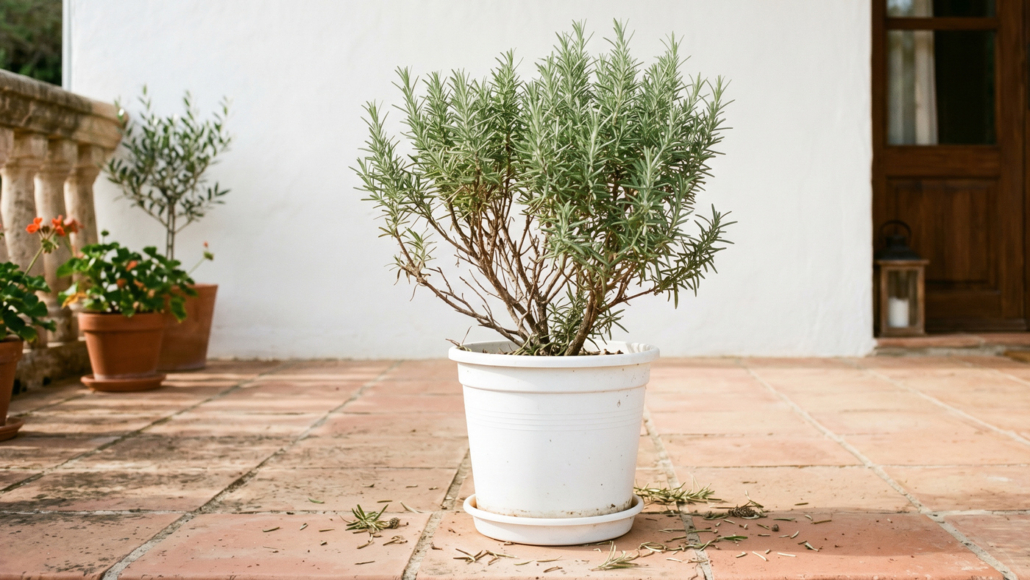
Pruning: this is my other big mistake, and honestly the one I’m still working on — I’ve let rosemary go too long without cutting it back, more than once, and ended up with a plant that was mostly bare, woody stem with just a few green tips left. By the time I noticed, it was too late to fix; rosemary won’t regrow from bare wood, only from green or semi-green growth, so skipping pruning isn’t a neutral choice, it’s a countdown.
Prune after flowering, cutting back into green growth by around a third to keep the plant compact and productive. Left unpruned for two or three years — which is exactly what I did — rosemary naturally develops that woody, bare base that can’t be reversed. If yours already looks like this, it’s not something you did wrong overnight; it’s just years of skipped pruning catching up, same as mine.
Read the full pruning guide : https://www.amazingherbgarden.com/how-to-prune-rosemary/
When something’s wrong
If your rosemary is browning, dropping needles, or generally looking unhappy, don’t guess — work through the diagnosis properly. I’ve laid out the full step-by-step process, starting with a simple scratch test to check whether a branch is even still alive, in my Why Is My Rosemary Turning Brown guide. It covers root rot (the most common cause by far), pests, powdery mildew, light and temperature stress, and how to tell a genuine problem apart from normal woody ageing.
FAQ
Is rosemary easy to grow indoors?
It’s possible but more demanding than outdoors, mainly due to light — most homes don’t have a spot bright enough without a supplemental grow light. Good air circulation also matters more indoors, where powdery mildew is more likely.
How long does rosemary take to grow from a cutting?
Roots typically take a couple of weeks to develop, and a cutting becomes a well-established, harvestable plant over several months to a year, depending on growing conditions.
Can rosemary survive winter outdoors?
Reliably in USDA zones 8–10. In zone 7, cold-hardy cultivars can survive with protection. Below that, it needs to come indoors or be treated as an annual.
Does rosemary need a lot of water?
No — the opposite. Established rosemary is quite drought-tolerant and is far more often killed by overwatering than underwatering.
What’s the difference between upright and trailing rosemary?
Upright varieties grow as compact shrubs and are generally better for cooking and hedging. Trailing (prostrate) varieties spread low and wide and are better suited to cascading over walls or containers.
Related reading:
Get the soil right from the start with my Best Soil Mix for Rosemary guide · already seeing trouble? Start with Why Is My Rosemary Turning Brown · growing mint alongside your rosemary? Here’s why it wants completely different soil conditions.
How to prune Rosemary – A step by step guide
What’s your biggest rosemary struggle right now — light, watering, pruning, or something else? Mine were watering and pruning, in case it’s any comfort — tell me yours in the comments and I’ll point you to exactly the right guide.
Leave a Reply
Want to join the discussion?Feel free to contribute!