
Why is my rosemary turning brown? (the real reasons, diagnosed)
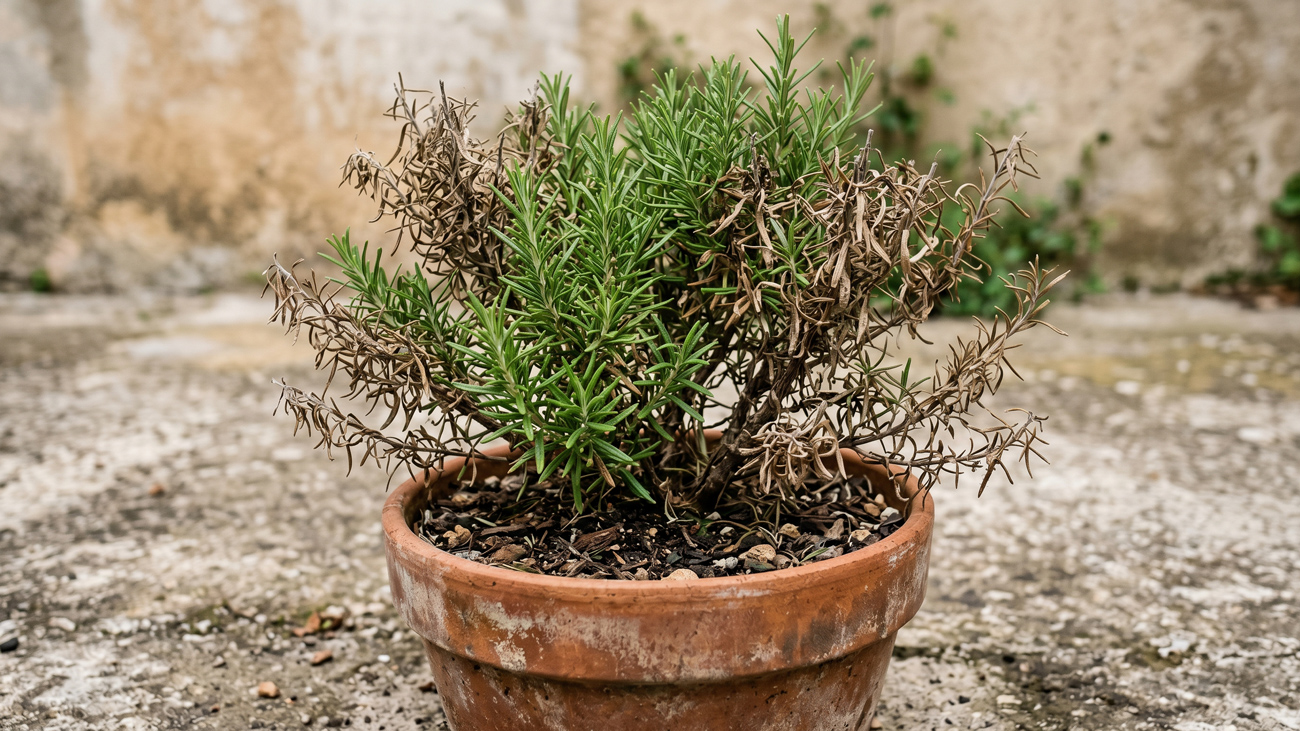
Quick answer: work through this in order
Before anything else: do the scratch test – on each affected branch, not just the main stem. Rosemary damage is often patchy: one branch can be badly hit while the one right next to it is completely fine, so testing only the main central stem can miss a damaged side branch entirely.
How to do it properly:
- Start near the tip of a branch that looks affected and scratch a small spot with your fingernail.
- Green, moist tissue underneath means that section is alive — move on to test the next branch.
- Brown and dry underneath means that section is dead — move a few centimetres further down toward the base and scratch again.
- Keep working down the branch until you hit a spot that’s green underneath, then cut just above that point with clean pruners.
- Repeat branch by branch across the whole plant. It’s normal to end up cutting some branches back further than others.
If every branch comes back brittle and brown all the way to the base with no green anywhere, the plant is realistically beyond saving.
Once you’ve triaged what’s alive and cut back what isn’t, work through the checklist below to find out why it happened — arranged from most common cause to least common, so most people will find their answer in the first two or three steps.
- Check the soil and roots — the single most common cause, by far
- Check for pests — spider mites, aphids, whiteflies
- Check for powdery mildew — the white, dusty coating
- Check the light — is it actually getting enough sun?
- Check recent temperatures — frost or extreme heat
- Check the plant’s age — sometimes it’s not a problem at all
Let’s go through each one.
1. Check the soil and roots (root rot — the most common cause)
If your rosemary is browning, especially with whole branches dying rather than just leaf tips, root rot is the most likely explanation. It’s also the cause I see people misdiagnose most often, because the visible symptom (brown leaves) looks identical to several completely different problems, while the actual problem is happening underground, out of sight.
What’s really going on: Rosemary’s roots evolved for lean, fast-draining, stony ground. In compact or constantly moist soil, the tiny air pockets roots need to breathe collapse, and a handful of common fungi — mainly Phytophthora and Pythium — move in and start rotting the roots from there. This can happen even if you’re watering on a perfectly sensible schedule, if the soil itself doesn’t drain fast enough to let the roots dry out between waterings.
How to check:
- Gently tip the plant out of its pot (or dig carefully at the base if it’s in the ground) and look at the roots.
- Healthy rosemary roots are pale and firm.
- Rotten roots are dark brown to black, mushy to the touch, and often come with a distinct sour or rotten smell.
- Check the soil itself, too: if it’s staying wet for days rather than drying out, or if water sits on the surface instead of draining through, that’s your underlying cause even before you look at the roots.
What to do about it:
- Trim away any mushy, dark roots with clean, sharp scissors or pruners — cut back to firm, pale root tissue.
- Repot into a genuinely fast-draining mix (see my full soil mix guide — a 2:1 compost-to-perlite ratio is the fix here, not just “less water”).
- Hold off watering again until the top few centimetres of the new mix have dried out.
- If more than half the root system is mushy, be realistic: recovery is possible but not guaranteed, and it may be worth taking a cutting from any remaining healthy green growth as a backup.
Prevention going forward: this is entirely a soil and drainage issue, not a “water less” issue in most cases — plenty of root rot happens to people watering a perfectly normal amount into the wrong mix. Always use a pot with a drainage hole, and never let a pot sit in a saucer of standing water.
2. Check for pests
If the roots and soil check out fine, look closely at the stems and undersides of the leaves next.
Spider mites are the pest most likely to cause overall browning, especially on indoor rosemary in dry, warm conditions. They’re tiny — you’ll often need a magnifying glass to see them clearly — but the damage is distinctive: fine stippling or speckling on the leaves, followed by scorched-looking brown patches, plus a fine silky webbing on the undersides of stems in worse infestations. A quick way to confirm: hold a sheet of white paper under a branch and tap it firmly — if mites are present, you’ll see tiny specks fall onto the paper, sometimes leaving a reddish-brown smear if you crush them.
Aphids cluster on soft new growth and flower buds rather than causing broad browning, but a heavy, sustained infestation can stunt and eventually brown the affected tips. Look for small green or grey insects clustered at the stem tips, often with a sticky residue (honeydew) nearby.
Whiteflies are more common on indoor or greenhouse-grown rosemary. They’re easy to confirm: gently shake the plant and look for a small cloud of tiny white insects lifting off.
What to do: for all three, a strong jet of water to physically dislodge them, followed by insecticidal soap or neem oil sprayed thoroughly on the undersides of the leaves, is the standard, low-risk treatment. Since rosemary is a culinary herb, avoid harsher chemical pesticides and stick to these gentler options, repeating every five to seven days until the infestation clears. Raising humidity around indoor rosemary also genuinely helps deter spider mites, since they thrive specifically in hot, dry air.
3. Check for powdery mildew
This one’s easy to identify and, thankfully, rarely fatal on its own. Look for a white or grey, dusty-looking coating on the leaves and stems, usually starting as small circular spots that merge into larger patches as it spreads. It thrives in warm, humid conditions with poor air circulation — which is exactly what happens when rosemary’s naturally dense, bushy growth traps still, damp air around itself, especially indoors or in crowded plantings.
What to do: prune out and discard the most affected stems first, then improve airflow — space plants further apart outdoors, or run a small fan nearby for indoor rosemary. A simple homemade spray of diluted milk (roughly one part milk to five to nine parts water) or a baking soda solution (about one teaspoon per litre of water) is a widely used, low-intervention treatment; apply in bright light every few days until it clears. Since you’ll likely be eating this rosemary, avoid stronger fungicides where a mild homemade spray will do the job.
4. Check the light
If the browning looks less like patches or spots and more like whole stems fading from the tips inward — thin, pale growth rather than crisp brown — insufficient light is a strong candidate, particularly for rosemary grown indoors. Rosemary needs the equivalent of six to eight hours of strong, direct sun; anything meaningfully less than that and the plant can’t photosynthesize enough to sustain all its growth, so it starts shedding its weakest stems first.
What to do: move the plant to your brightest available window, or add a grow light running eight to ten hours a day if natural light genuinely isn’t enough. Trim back the dead stem tips to healthy green growth once the light problem is fixed, so the plant can redirect its energy rather than trying to maintain tissue that’s already gone.
5. Check recent temperatures
Cold damage: rosemary is a Mediterranean herb and doesn’t take kindly to frost. Established plants can generally tolerate a light, brief frost, but sustained exposure below around 0°C (32°F) is where damage typically starts to show as shrivelling and browning over the following days. Prolonged cold well below that — commonly cited as roughly -7°C to -12°C (10–20°F) — is enough to kill most standard rosemary varieties outright, though a handful of cold-hardy cultivars (such as ‘Arp’) have been bred to survive considerably colder conditions. If you’re gardening somewhere with real winters, this is worth checking against your specific variety and local hardiness zone before assuming the worst.
Heat stress: less common, but worth knowing — sustained temperatures above roughly 38°C (100°F) combined with insufficient water or airflow can stress rosemary too, showing up as wilting or browning despite otherwise reasonable care.
What to do: for cold damage, don’t rush to cut everything back immediately — wait to see which parts recover once temperatures stabilise, then trim only what’s confirmed dead via the scratch test. For future protection, bring potted rosemary indoors before a hard frost, or use a frost cloth over in-ground plants during cold snaps.
6. Check the plant’s age — sometimes this isn’t a problem at all
Here’s something most competing articles skip entirely, and it’s worth knowing before you assume the worst: rosemary left unpruned for two or three years naturally develops a woody, bare-brown base with green growth only at the newer tips. That’s not disease, pests, or a care mistake — it’s simply what an ageing, unmanaged rosemary plant looks like.
The catch is that this one genuinely can’t be reversed by pruning after the fact: rosemary won’t regrow from cuts made into fully bare, woody stems, only from green or semi-green growth. So if your plant’s base has gone entirely woody, the browning there is permanent, though the plant itself can still be perfectly healthy going forward with proper annual pruning from here on. See my full pruning guide for exactly how to keep this from happening again.
A quick note on telling overwatering and underwatering apart
Both can cause browning, and it’s a genuinely easy mix-up. As a rough rule: root rot from overwatering tends to produce soft, mushy, dark stems and a sour smell at the base, alongside wet or slow-draining soil. Underwatering tends to produce dry, crisp, brittle brown leaves with soil that’s pulled away from the pot’s edges and feels bone-dry throughout. If you’re not sure which you’re looking at, the soil-and-root check in Step 1 will usually settle it either way.
When it’s beyond saving
If the scratch test comes back brown and brittle across the entire plant, with no green tissue anywhere, it’s realistically time to start again rather than keep nursing it. That’s a normal outcome sometimes, not a reflection of anything you did wrong — and it’s a good excuse to try propagating your next one from cuttings rather than buying another full plant. (More on that in my upcoming cuttings guide.)
FAQ
Why is my rosemary turning brown from the bottom up?
This is most often either natural woody ageing (see Step 6) or root rot (Step 1). Check the roots first, since that’s reversible if caught early — ageing at the base isn’t.
Can a brown rosemary plant come back to life?
Yes, if there’s still green tissue on at least some branches when you scratch-test them individually. Cut back only the branches that test brown all the way down, address the underlying cause, and give the rest time to recover.
Is it normal for rosemary to have some brown leaves?
A small amount of natural leaf drop and occasional browning on old inner growth is normal, especially on an older plant. Widespread browning across whole stems is not.
How do I know if it’s root rot or just underwatering?
Root rot roots are dark, mushy and often smell sour; the soil is usually wet or slow-draining. Underwatered roots and soil are simply dry throughout. Tip the plant out and check if you’re unsure.
Should I fertilise a browning rosemary plant to help it recover?
No — hold off on fertiliser until you’ve identified and fixed the actual cause. Feeding a stressed plant, especially one with root damage, can make things worse rather than better.
Related reading:
Get the soil right from the start with my Best Soil Mix for Rosemary guide · the full Growing Rosemary guide covers everything else · if your plant’s gone woody at the base, my Pruning Rosemary guide explains how to prevent it next time.
Has your rosemary bounced back from something like this before? Tell me what it was and what worked — it might be exactly what someone else reading this needs to hear right now.
Leave a Reply
Want to join the discussion?Feel free to contribute!